2016 #INFOSWMM Tweets about #HYDROLOGY #CSO #SWMM5

  1. We welcome in DC as our newest client...looking forward to helping in their upcoming modeling projects.

Job Posting - Sediment and Water Quality Transport in Urban Watersheds Research Participation Program Office of Research and Development National Risk Management Research Laboratory U.S. Environmental Protection Agency (EPA)

Sediment and Water Quality Transport in Urban Watersheds
Research Participation Program
Office of Research and Development
National Risk Management Research Laboratory
U.S. Environmental Protection Agency (EPA)

EPA-ORD/NRMRL-WSWRD-2015-04

Project Description:


Extra Note: Water resources job opening with in Cincinnati, Ohio for someone with a masters or PhD:
A postgraduate research project training opportunity is currently available at the U.S. Environmental Protection Agency’s (EPA), Office of Research and Development (ORD)/National Risk Management Research Laboratory (NRMRL). The appointment will be served with the Water Supply and Water Resources Division (WSWRD) in Cincinnati, Ohio. 
The WSWRD conducts research on microbial contaminants, water treatment technology, urban water management, and water quality controls for the benefit of the nation. 
The research opportunity will include activities such as:
  • Formulation of numerical techniques for simulation of nutrient and sediment water quality transport.
  • Development of initial solution prototype.
  • Testing of prototype with analytical, synthetic, and field study data.
  • Development of production code for SWMM based on prototype experience
  • Preparation of research products documenting methodology and results. 
The research participant will gain:
  • Experience with numerical solution of advection-diffusion-reaction equations
  • Knowledge of overland flow hydrology and numerical simulation of open channel flow hydraulics
  • Experience with object oriented software design
  • Experience developing software in C/C++.

Qualifications:

Applicants must have received a master’s or doctoral degree in civil/environmental engineering, hydrology, environmental science, or other related discipline within five years of the desired starting date, or completion of all requirements for the degree should be expected prior to the starting date.
The program is open to all qualified individuals without regard to race, sex, religion, color, age, physical or mental disability, national origin, or status as a Vietnam era or disabled veteran. U.S. citizenship or lawful permanent resident status is preferred (but a candidate also may hold an appropriate visa status; an H1B visa is not appropriate). Guidelines for non-U.S. citizens may be found at http://orise.orau.gov/epa/applicants/immigration.htm. 
The appointment is full time for one year and may be renewed upon recommendation of EPA and contingent on the availability of funds. The participant will receive a monthly stipend. Funding may be made available to reimburse the participant's travel expenses to present the results of his/her research at scientific conferences. No funding will be made available to cover travel costs for pre-appointment visits, relocation costs, tuition and fees, or a participant's health insurance. The participant must show proof of health and medical insurance. The participant does not become an EPA employee.

Technical Questions:

The mentor for this project is Michael Tryby (tryby.michael@epa.gov). 

How to Apply:

An application can be found at http://orise.orau.gov/epa/applicants/application.htm. Please reference Project # EPA-ORD/NRMRL-WSWRD-2015-04 when calling or writing for information.

New - Five Infiltration Options Now in InfoSWMM v14 and H2OMap SWMM v14 for Watershed Modeling

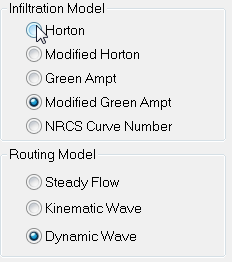
Infiltration from the pervious area is a marvelous and from a runoff volume and runoff peak perspective a vital process in modeling the hydrology and ultimately the hydraulics of your Watersheds.  Figure 1 shows the five options available in InfoSWMM and H2OMap SWMM after the version 14 update which was based on the EPA SWMM 5.1.010 release:
Storm cloud Horton
Storm cloud Modified Horton
Storm cloud Green Ampt
Storm cloud Modified Green Ampt
Storm cloud Curve Number
Not only can you have a different Infiltration option per Model Simulation but you can have different options for each scenario and even for individual Subcatchments in a Scenario (Figure 2).  In #InfoSWMM and H2OMap SWMM the Soil DB table (Figure 3) shows the individual parameters that apply to Horton, Green Ampt and Curve Number infiltration. The Modified Horton and Green Ampt have the same parameters as the Horton and Green Ampt Soil Types.  The Soil Coverage is specified in the Subcatchment DB Table or individually in the Subcatchment Attribute Browser (AB) as shown in Figure 4.  You can also see the infiltration losses for either multiple Subcatchments or for one Subcatchment across many scenarios using the Advanced Reference Graphics Analysis in Innovyze’s InfoSWMM and H2OMap SWMM (Figure 5).
SNAGHTML9c87283
Figure 1. Five Infiltration Options in the Run Manager
SNAGHTML9d0088b
Figure 2. The Marvelous Scenario Explorer in Innovyze Arc GIS products allows you to customize the Infiltration Options per Scenario and Dataset.
SNAGHTMLd4190fe
Figure 3. A key to getting good infiltration results is defining the infiltration parameters in the Soil DB Table.
SNAGHTMLd42bbd5
Figure 4. You can also define both your Soil parameters and Soil Coverage for each Subcatchment in the Attribute Browser.
SNAGHTML9d25794
Figure 5. The feature rich Output Report Manager allows complete customization of the graphs using other scenarios, calibration data and other other output elements.

Soil Water Characteristic Estimates by Texture and Organic Matter for Hydrologic Solutions Saxton and W. J. Rawls


New EPA SWMM 5 Hydrology and User Guide now Downloadable from the EPA site.

New EPA SWMM 5 Hydrology and User Guide now Downloadable from the EPA site. 


Downloads

Date
Description
09/21/2015
Storm Water Management Model Reference Manual Volume 1 - Hydrology (PDF) (235 pp, 3.8 MB)  July 2015, EPA No. 600/R-15/162.
08/05/2015
09/30/2015
07/06/2010
08/05/2015
08/05/2015
08/05/2015
08/05/2015
09/19/2006
05/25/2005